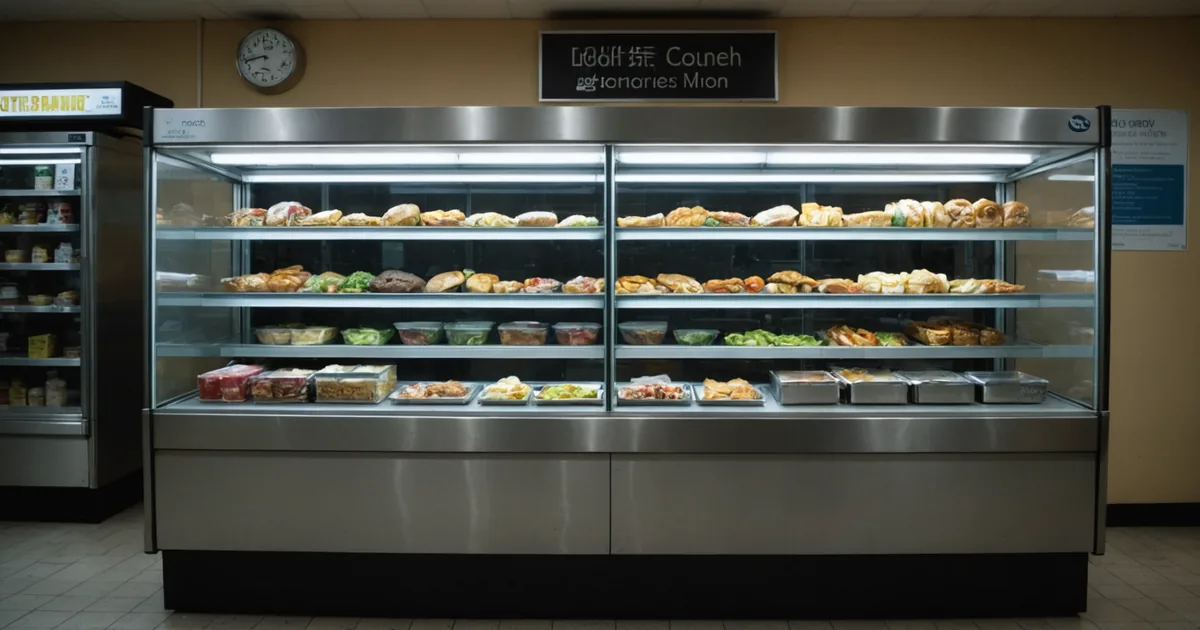
Hot food in transit hubs, high-footfall offices, and shift-staffed leisure venues follows a recognisable failure pattern. It starts reasonably well at the beginning of the service window, when food is fresh and the person managing the pass is present and attentive. By mid-service it is inconsistent. By late-service it is either sold out with nothing to replace it, or it has been sitting in a cabinet for too long and no one has removed it. This pattern repeats regardless of the operator's intentions because it is structural, not accidental.
Understanding the structure of the failure is a prerequisite for understanding what can and cannot be fixed by technology. Cook-e addresses one part of the structural problem. It does not address all of it. This article is about both the problem and the limits of what any single technology can fix.
The attention decay problem
In any staffed hot food operation, the quality of the service correlates closely with how much of the operator's attention the hot food pass is receiving at any given moment. At the start of a shift, when the line is freshly loaded and the kitchen team is focused, attention is high. As the shift progresses, demands compete: a customer with a complex order at another counter, a delivery arriving that needs signing, a queue forming at a checkout. The hot food pass is a passive background task that does not announce its own needs loudly enough to compete with immediate demands.
The result is that nobody notices when a tray of chicken portions has been sitting for 90 minutes past its optimal hold window. The tray is not visually distinct from a tray that is within its window; the difference is time, and nobody has been tracking time per tray. The food is removed when a customer complains, when someone finally notices it has dried out, or when the end of the service window triggers a line clear. The damage to quality happened long before it was detected.
This is the first structural failure: the monitoring problem in a staffed operation is not solved by having staff present. It is solved by having the right kind of attention on the right thing at the right time, which is a harder requirement than headcount alone.
The shift handover problem
High-turnover spaces tend to have shift-based staffing. A morning team works from 06:00 to 14:00; an afternoon team takes over. At the handover point, information about what is in the holding cabinet, how long it has been there, and what needs to be removed does not transfer reliably unless there is a formal system for it.
In practice, most small and medium-sized catering operations do not have a formal hot food handover protocol. The incoming team looks at what is in the cabinet, makes a rough assessment based on appearance, and makes a call about what to keep and what to discard. The call is frequently wrong in one of two directions: good food is discarded because it looks older than it is (surface colour change is not a reliable hold-time indicator), or food that is past its hold window is kept because it looks acceptable and discarding it is a cost.
The shift handover problem is a knowledge problem: the incoming team does not know what the outgoing team knew. Per-tray time logging solves this problem directly. If every tray in the cabinet has a recorded load time and a calculated remaining hold window, the incoming team does not need to make a judgment call. The system tells them which trays are in window, which are approaching the end, and which should have been removed already. This is Cook-e's hold management system applied to the shift handover context.
The labour-demand mismatch problem
Hot food demand in high-turnover spaces is not uniform. It peaks sharply at meal times and drops to near zero between them. Staffing a hot food pass for the full operating hours of a transit hub to serve only the 90-minute lunch peak is economically unreasonable. So operators staff the peak and leave the off-peak hours unattended or covered by non-specialist staff who may not prioritise the hot food pass.
The result is a predictable pattern: good service at the peak when the specialist is present, poor or absent hot food service outside the peak when they are not. For transit environments where eating patterns are not constrained to standard meal times, this means a substantial portion of the customer base that would buy hot food at off-peak hours finds either nothing available or food that has been sitting since the last peak service was cleared.
The labour-demand mismatch is not a technology problem at its root. It is an economics problem: the cost of having a skilled person at the pass is not justified by the revenue available during off-peak hours. Technology that removes the requirement for a skilled person at the pass changes the economics of off-peak hot food service. Cook-e is designed specifically to address this case: to make it economically viable to offer hot food at times when staffing a dedicated pass position is not justified.
What technology does not fix
We want to be specific about this, because overstating what technology fixes is one of the ways the catering industry has repeatedly wasted money on solutions that did not address the actual problem.
Technology does not fix the food supply problem. A cabinet with automated hold management still needs to be loaded with food. If the food supply is unreliable, if deliveries are late, if the prep kitchen cannot produce enough par-cooked items to fill the cabinet before a service window, the technology does nothing. The supply chain behind the hot food pass is an operational problem, not a hardware problem.
Technology does not fix the product quality problem. If the food going into the cabinet is mediocre, the cabinet will hold mediocre food at a consistent temperature. Vision-based doneness classification and hold window management make a consistent product better; they do not make a poor product good.
Technology does not fix the commercial problem. An unattended hot food cabinet in a location without demand for hot food at the times it is operating will not generate revenue. The question of whether there is sufficient demand to justify the operational overhead of a hot food service at a given location is a commercial question that needs to be answered before investing in the hardware.
The specific problem Cook-e is solving
Cook-e addresses the monitoring problem and the labour-demand mismatch. It does not address the food supply problem, the product quality problem, or the commercial demand question. Operators who come to us expecting the hardware to solve all four problems will be disappointed. Operators who understand the labour-demand mismatch and monitoring problem as the binding constraints in their specific environment, and who have already solved or are addressing the other three, are the ones who get value from the technology.
The structural failure of hot food in high-turnover spaces has multiple causes. Fixing one cause helps; it does not guarantee the service works. The monitoring and hold management problem is the one we can definitively solve. The rest is operational discipline, food quality, and commercial judgment. Those are the operator's domain, not ours, and we are not going to pretend otherwise.