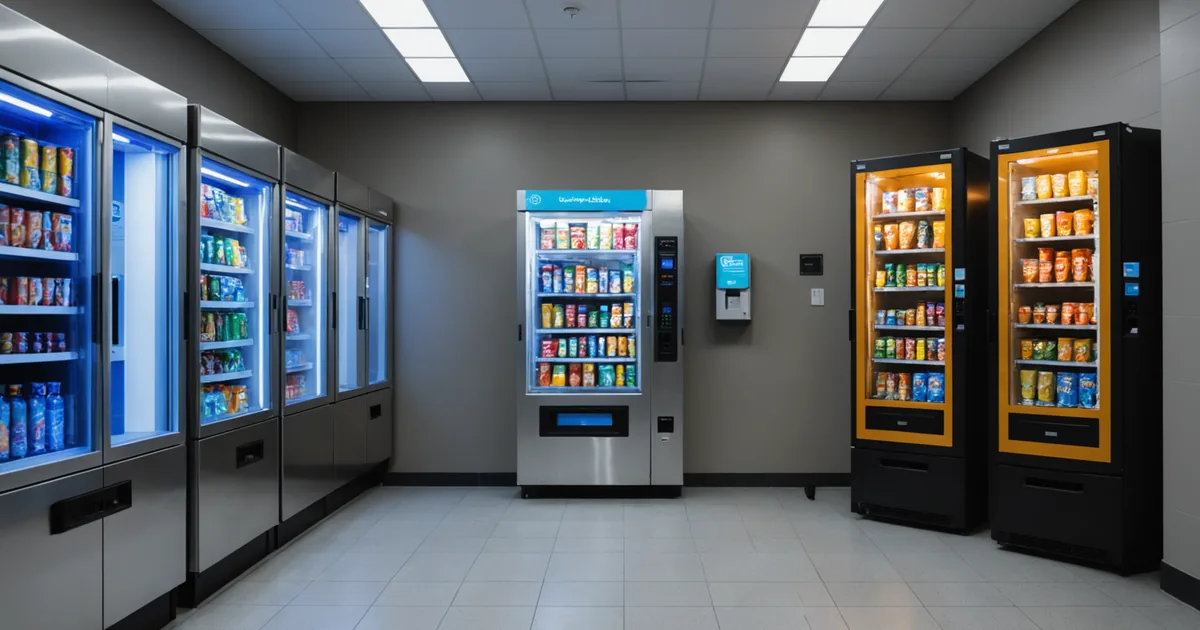
Operators evaluating Cook-e sometimes ask how it fits relative to vending machines or ambient grab-and-go food units. The question is reasonable: all three are unattended food formats. But they serve different customer needs, operate on different economics, and are suitable for different deployment contexts. Conflating them leads to mismatched expectations, so it is worth mapping the territory clearly.
Traditional vending machines: ambient and chilled
The standard vending machine is an ambient or chilled retail format. It stores pre-packaged food at ambient temperature (for shelf-stable items like crisps and confectionery) or at refrigerated temperature (for sandwiches, salads, and chilled drinks). The machine dispenses the item but does not change its temperature or state.
The economic model for vending is well established: low labour cost, high SKU flexibility, remote telemetry for stock monitoring, and a large installed base of service and logistics infrastructure. Vending machines are commercially proven in high-footfall environments and require relatively low capital outlay per unit compared to more complex food service equipment.
The constraint is the product category. Ambient vending does not deliver hot food. Chilled vending offers food that is ready to eat cold, which is what many customers want for a quick snack, but it does not serve the specific customer desire for a hot meal at the pass. The heat barrier is the definitional limit of the format: the machine's core function is storage and dispensing, not temperature management of cooked food.
Cook-e is not competing with traditional vending for the crisps-and-drinks market. The two formats are complementary in most deployment environments: vending handles ambient snacks and cold drinks; Cook-e handles hot meal items. An operator running both is serving the full range of impulse food and drink needs at a concession point without any staffing requirement for either format.
Ambient grab-and-go
Ambient grab-and-go is the sandwich-and-pastry format: pre-packaged, shelf-stable or short-life refrigerated items displayed in an open or glazed unit at ambient or mild refrigeration. This is the standard format in most UK and French motorway service areas, supermarket concessions, and quick-service grab-and-go areas in transit environments.
From an operator economics perspective, ambient grab-and-go has very low complexity: no temperature management, no cooking, minimal food safety risk in the holding step. The food safety risk is managed at production (commercial sandwich production with formal food safety controls) and at the point of sale through use-by date management. The operator's role is restocking and date checking.
The limitation is the same as vending: the product is cold. A wrapped chicken and salad sandwich at 4 degrees celsius is a different product from a hot chicken portion at 70 degrees celsius. They are not substitutes for the same customer desire.
There is a hybrid format worth noting: hot-to-go displays, where ambient grab-and-go units include a warming section that raises packaged items to a mild warm temperature without the precision of hot-holding at 63 degrees celsius. These exist in some convenience formats. They are typically unmonitored and produce inconsistent results. This is the format that Cook-e is most directly improving on in terms of the technical approach: replacing "warm-ish" with properly monitored holding.
Hot cabinet service: where Cook-e sits
Cook-e is a hot-holding cabinet with automated doneness classification and hold window management. It serves hot cooked food at proper holding temperature with per-tray state monitoring. This is a different product category from vending or ambient grab-and-go, and it competes with staffed hot food service rather than with vending or grab-and-go formats.
The comparison to make is not Cook-e versus a vending machine. The comparison is Cook-e versus a staffed hot food counter. Both serve hot cooked food at proper holding temperature. The difference is that a staffed counter requires a trained person at the pass and Cook-e does not.
On capital cost, a staffed hot food counter requires hot-holding equipment (EUR 2,000 to 4,000 for commercial-grade units), plus the labour cost of the person managing the pass. Cook-e's hardware cost is in a similar range (EUR 4,500 to 4,900 per unit), plus the software monitoring subscription. The economics favour Cook-e when the alternative is paying a full-time or part-time kitchen staff member to manage the pass during service windows, particularly for service windows that are short (less than four hours) or at times when staffing premiums apply (evenings, weekends, overnight).
Where each format fits
The clearest way to map the three formats is by customer intent and by the operator's ability to staff the service point.
Vending and ambient grab-and-go fit where: (a) the customer want is a snack, drink, or cold meal item, not a hot meal; (b) the operator needs a zero-labour format; (c) the product range is shelf-stable or short-life chilled. These conditions hold for the majority of concession points in transit environments. Vending and grab-and-go are the right formats for these cases and Cook-e is not a replacement for them.
Cook-e fits where: (a) the customer want is a hot meal; (b) the operator cannot or does not want to staff the hot food pass; (c) the product range includes cooked protein and other hot-hold compatible items. This conditions hold in environments where hot food demand exists but where staffing the pass is economically difficult or operationally impossible: late-night service windows, office canteens without dedicated kitchen staff, transit concession points with variable footfall patterns.
The two categories are additive rather than competitive. An operator adding Cook-e to a concession point that already has vending is extending the range of food needs they can serve, not replacing what they have. The hot food demand that goes unserved when only vending is available is a separate demand from the cold snack demand that vending already captures.
Operator economics: the question to ask
When an operator is evaluating whether Cook-e makes sense for their environment, the question to ask is not "is a hot cabinet better than a vending machine?" They serve different customer needs. The question is: "do I have meaningful hot food demand at times or in locations where I cannot staff the pass?"
If the answer is yes, and the demand is consistent enough to justify the hardware and operational overhead (loading, restocking, cleaning), then Cook-e's economics typically close. The specific threshold depends on the operator's cost structure, the price point they can charge for hot food items, and the volume of demand at the target service times.
We do not publish a "minimum viable covers per day" number because the answer varies significantly by operator context: a transit hub with a captive audience at breakfast hour has a different cost structure from a leisure venue with variable late-night demand. What we can say is that the capital cost of the equipment is recoverable at lower volume than a staffed counter model, because the ongoing labour cost is absent. The crossover point depends on the specifics. We encourage operators to run the numbers for their own environment, and we are happy to work through the economics with operators who are evaluating the format.