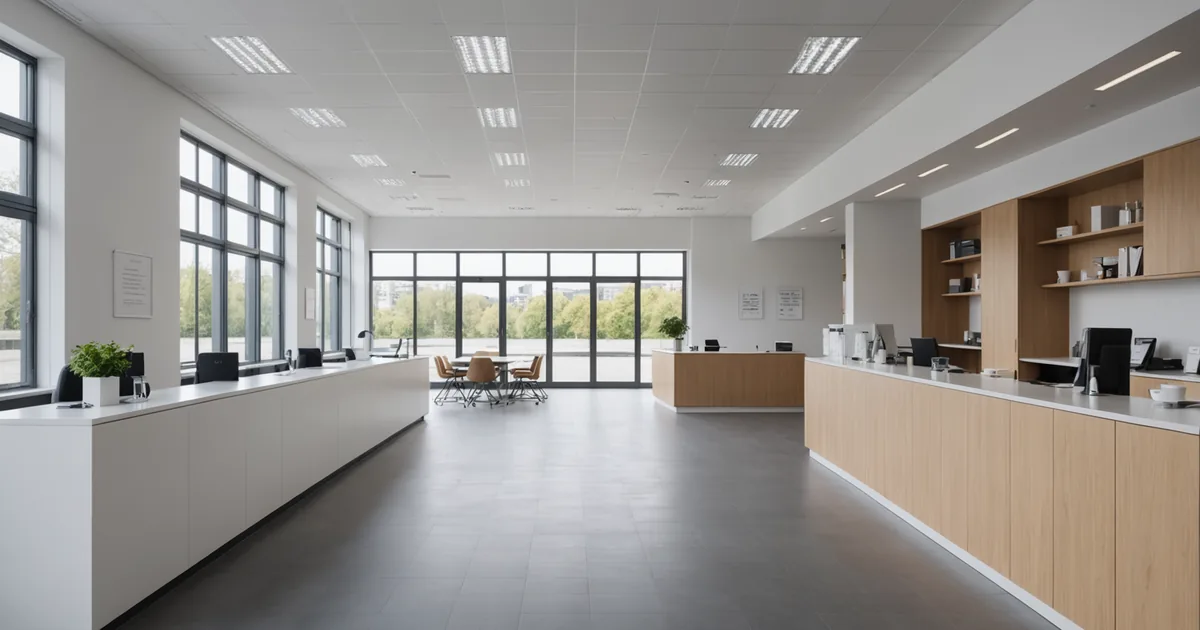
The workplace lunch problem is not about food quality, exactly. It is about who is responsible for delivering it in the absence of someone whose job is food. That person is increasingly absent. And the gap they leave is not a minor inconvenience. It is a daily operational failure that affects employee experience and, where the employer is paying for food as a benefit, produces a material waste cost.
We have talked to facilities managers at office buildings across Paris and the wider Ile-de-France region over the past year. The pattern that comes up repeatedly is the same: a canteen or kitchen that was designed for a staffed service model is now being run on a part-time or fully unstaffed basis, and the people managing it were not hired to cook.
The 90-minute problem
The lunch peak in a typical office building runs from approximately 11:45 to 13:15. Outside that window, demand drops to near zero. A hot food service operation needs to be capable and running during that window, and only during that window.
In a building with 200 to 400 people, that 90-minute window might represent 100 to 150 hot meal requests. Not all at once; they distribute across the window. But the service needs to be ready at 11:45, quality needs to hold through the peak, and everything needs to be cleaned up and cleared by 14:00 so the kitchen area is available for the afternoon.
The traditional solution is a contract caterer who staffs the kitchen for the full service window. The caterer provides trained kitchen staff, handles food production or delivery, and manages the pass. This works. It also costs roughly 15 to 25 euros per meal served at scale in Paris, when all costs including labour are factored in, which makes it economically viable only for employers who are subsidising meals significantly or running very high volumes.
For buildings outside that scale range, the numbers rarely work. The facilities manager ends up managing the kitchen themselves, pulling in reception or admin staff to cover the lunch rush, and serving food whose quality depends entirely on whoever happens to be in the kitchen that day.
Facilities staff are not cooks
This is not a criticism of facilities professionals. It is a structural observation that has operational consequences.
A facilities manager's expertise is building systems: HVAC, access control, cleaning schedules, supplier contracts. They are responsible for a vast range of operational functions. Making consistent food quality decisions under time pressure during a lunch peak is not a natural extension of that expertise, and expecting it to be is a recipe for inconsistency.
The specific failure mode we see most often is not dramatic. It is not food that is dangerously undercooked or visibly wrong. It is food that varies in quality from day to day because nobody knows when exactly an item is ready, so someone makes a judgment call, and that judgment call is different on different days depending on who is in the kitchen, how busy they are, and how confident they feel about the food state.
On Mondays a chicken breast might come out at perfect hold temperature. On Thursdays the same product sits fifteen minutes too long because the person managing the kitchen got pulled into a building issue at the wrong moment. Employees notice. Canteen satisfaction goes down. The employer's investment in the food benefit is partially wasted on negative experiences.
What a canteen that runs itself actually needs
The framing we find most useful is not "automation of the kitchen" in some broad sense. It is: which specific decision point in the lunch service requires culinary judgment, and can that decision point be handled by a system instead of a person?
The decision point is doneness assessment and hold management. Someone needs to know when food is ready and when to pull it. Everything else in the lunch service, ordering, receiving deliveries, loading the cabinet, clearing trays after service, is a procedural task that facilities staff can do well without culinary expertise. The doneness judgment in the middle is the hard part.
Cook-e's role in a workplace canteen is to own that specific decision. The facilities staff load the cabinet before the peak, and the cabinet handles the rest: classifying when each item reaches its hold window, tracking time since ready classification, alerting when items need to be pulled. The person loading the cabinet does not need to know when the chicken is done. The cabinet tells them.
The load-once operating model
For most office lunch operations, the practical deployment model is a single load before the service window, with a replenishment cadence during service if volume demands it.
A cabinet loaded at 11:15 with sufficient capacity to cover the peak through 13:00 means the facilities team has one task: prepare and load food before 11:15. The cabinet handles doneness and hold management through the peak. If volume is high enough that replenishment is needed at 12:30, that is a second load task. If volume is lower, a single load may carry the full peak.
This operating model is achievable with Cook-e because the tray capacity is sufficient for a medium-size office building's peak demand, and because per-tray tracking means items loaded at 11:15 and items loaded at 12:30 are managed independently. The system does not average them or treat the later load as extending the earlier load's hold window.
The counterpoint: what this approach does not replace
We want to be direct about the limits. A vision-controlled holding cabinet does not produce food from scratch. The food still needs to be prepared or delivered. For most office operations, that means a central kitchen delivery from a catering supplier, or par-prepared items delivered daily. The cabinet holds the food and manages the pass; it does not cook from raw.
It also does not replace a full canteen experience in buildings where that experience is a meaningful employee benefit. A cook who is present and engaging, who prepares food to order, who runs specials, is a different product from an unattended cabinet with consistent hot-held options. We are not arguing that the two are equivalent. We are saying that for the significant number of workplaces where the full-service canteen model is not economically viable, an unattended cabinet with proper doneness control is substantially better than ad-hoc facilities-managed food service.
The last unserved shift is not the lunch hour where food was never provided. It is the lunch hour where food was provided badly, inconsistently, or at a quality level that did not justify its cost. That is what Cook-e is designed to address in the workplace context: consistent quality through the peak, without requiring a trained cook to be present.