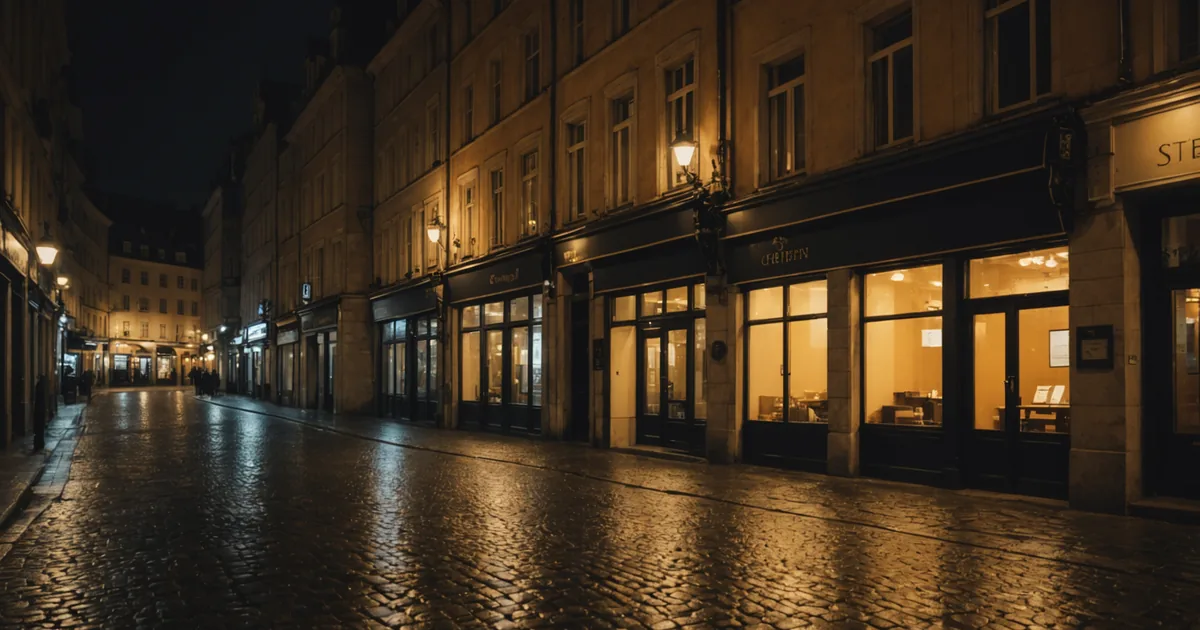
There is a specific time in a European city centre when hot food becomes unavailable. In Paris, it tends to be somewhere between 22:00 and 23:00 for most of the city outside the tourist corridors. In London it is later, maybe 23:30 in most boroughs. In smaller cities it can be as early as 21:00. The restaurants close, the canteens close, the coffee shop that sells paninis stops its hot service. What remains is delivery apps (with 30-40 minute waits), a kebab shop with inconsistent quality, and vending machines offering crisps.
This is a late-night food desert. It is not a food desert in the traditional policy sense, the kind studied in public health research as a function of income and geographic access. It is a time-based food desert: the food exists, the infrastructure exists, but the hours of operation do not match the hours when people are present and hungry.
Who is affected
The people present in a city centre after 22:00 are not a random sample of the population. Several distinct groups are reliably there and reliably hungry.
Hospitality workers finishing evening shifts. A bar team finishing at 00:30 after a Saturday night has, in most city centres, no hot food option that is not delivery or a street-food vendor if they are lucky. These workers typically cannot afford to eat delivery regularly on their wages, and they have been on their feet for eight hours.
Night-shift transport workers. A metro driver whose shift ends at 02:00, a night bus driver on a break at 01:00, needs something substantial. Vending machine snacks are not that. For workers with long gaps in their shift patterns, a reliable hot food option close to their station or depot is a meaningful welfare consideration.
Late-night leisure venue customers. A group leaving a concert at 23:15, a couple finishing a late dinner at a restaurant that closes its kitchen at 22:30, people leaving a late cinema screening. These customers have spending power and are actively looking for food. The demand is there; the supply is not.
Travellers at transit hubs with late-night departures. The 23:45 overnight train from Paris to Nice boards passengers who have been travelling since the afternoon. A hot meal option in the station at 23:30 is a revenue opportunity for the concession operator that currently does not exist at most stations because the staffed food counter closed at 21:00.
Why the food disappears
The obvious answer is labour cost. Running a staffed kitchen or food counter after 22:00 requires paying a late-shift premium on top of already-elevated hospitality labour rates. In France, where social charges add substantially to the base wage, a staffed food counter running from 22:00 to 02:00 needs to generate significant revenue just to cover labour. Most city centre locations cannot reliably generate that revenue at that hour without a captive audience (airport, major station, casino).
The less obvious answer is that the food safety and quality control requirements for hot food service do not relax at night. A holding cabinet running unattended needs someone who understands doneness, who can tell when an item is ready to serve and when it has passed its hold window. Without that person, the operator faces a choice: close the hot food service, or accept quality and safety risks from food that is held without monitoring.
Most operators choose to close. The risk of a food safety incident during an unmonitored night service outweighs the revenue from the small late-night customer base. This is a rational decision given the current state of hot food holding equipment, which is designed to maintain temperature but not to manage doneness or hold windows autonomously.
The specific gap Cook-e addresses
Cook-e is not a solution for all late-night food desert problems. It does not deliver food. It does not stock itself. It requires someone to load it at the start of the service window, even if it then runs unattended for several hours.
What it enables is a hot food service that runs through a late-night window without requiring a trained cook to be present at the pass throughout. An operator can load the cabinet at 21:30 for a 22:00 to 02:00 service window, and the cabinet will handle doneness classification and hold management autonomously through that window. Bar staff, reception, or security personnel can serve customers by taking a tray from the cabinet when it indicates an item is ready. They do not need to know whether the chicken is done. The cabinet tells them.
The restocking question is the remaining operational challenge. A cabinet with ten tray positions loaded at 21:30 will cover perhaps 50 to 80 individual serves depending on item size and portion format before it needs a reload. For a late-night venue with moderate food demand, that may be enough for the full service window without a mid-window reload. For a busier venue, a reload at midnight may be necessary. That reload still requires a person to handle food and load trays. The cabinet's role is to manage the pass, not to operate as a fully autonomous kitchen.
Economics of late-night unattended service
The economics change materially when you remove the cook from the late-night pass cost. A cabinet with a hardware and software cost (at Cook-e's current pricing) spread over a three-year operating life represents a per-serve cost that is substantially lower than the marginal labour cost of staffing a late-night cook for a four-hour service window, even at low cover counts.
We want to be careful not to overstate this. The cabinet is not free to operate. There are food costs, restocking labour costs, maintenance, and the capital cost of the equipment. For an operator with very low late-night demand, say fewer than 20 covers per night, the economics may not close. For an operator with consistent late-night demand of 40 or more covers per service window, the model is more clearly viable.
The operators who make most sense for late-night unattended hot food service are those with a captive audience: a late-night transit station, a venue with a late licence, a hospital staff cafeteria serving night shift workers. These are not random-footfall locations. They have predictable demand at predictable times from a known population. That predictability is what makes unattended service viable: the operator can load the right quantity at the right time because they know roughly how much will be needed.
The food safety framework at night
One concern operators raise when considering late-night unattended service is food safety oversight. During the day, a trained staff member present at the pass provides a layer of practical food safety monitoring. At night, with no cook present, who is checking that food is at safe holding temperatures?
Cook-e's temperature monitoring and logging handles this continuously. Every tray position's holding temperature is recorded at regular intervals through the service window. If a temperature drops below the configured minimum (typically aligned with national food safety guidance on hot holding temperature minimums), an alert fires regardless of the hour. The log is available for food safety inspection purposes and covers the full service window including the unattended overnight hours.
We are not saying this is equivalent to a trained food safety officer being present. We are saying it provides a documented, continuous temperature record that exceeds what many staffed operations actually produce, where manual temperature checks may be done at intervals and recorded on paper. The automated log is a higher-frequency record than most operators currently maintain.
Late-night food deserts exist because the staffing model that enables hot food service breaks down after business hours. The monitoring and doneness problem, not just the labour cost problem, is a significant part of why. Cook-e addresses the monitoring problem. The labour cost arithmetic follows from that.