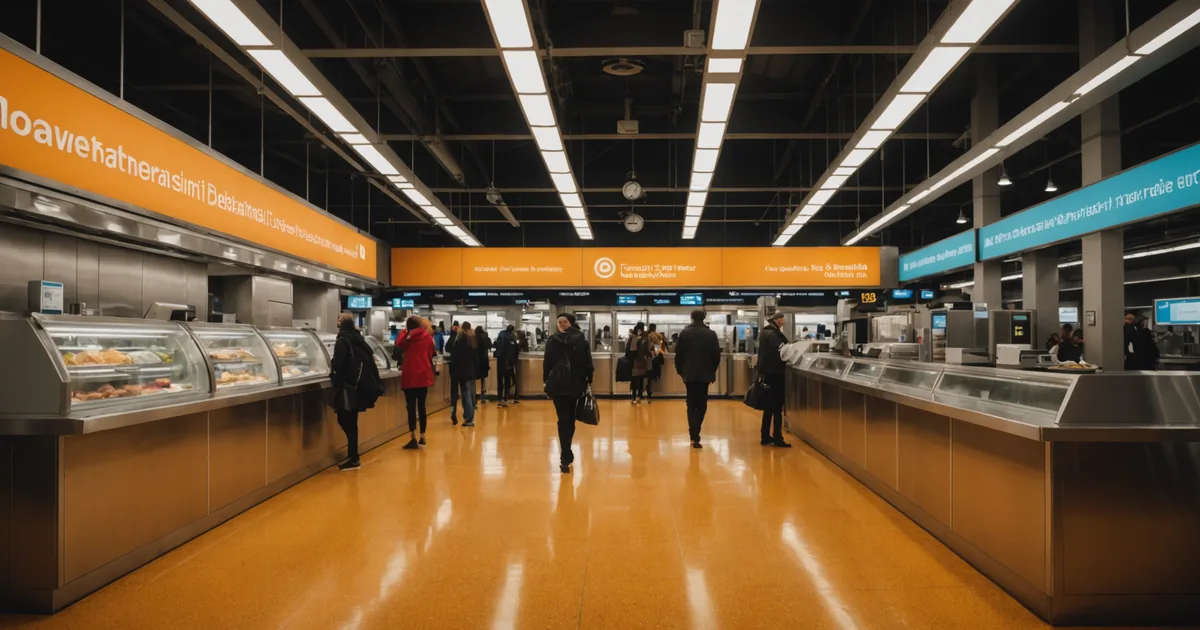
Transit hubs have a structural problem with hot food that does not have a clean solution in the current landscape of food service equipment. Walk through most mid-size train stations in Western Europe at 07:30, and you will find three kinds of food available: vending machine cold snacks, a grab-and-go ambient section with sandwiches and pastries, and, if you are lucky, a staffed counter selling coffee. Hot food is typically either absent or limited to a single staffed counter with a 20-minute queue.
The gap is not demand. Commuters and travellers want hot food. The gap is the pass: the moment food leaves the heating environment and gets handed to a customer. Without someone at that pass, hot food service does not function reliably. This article is about why that problem is harder than it looks and what a working solution actually requires.
Why transit operations cannot staff the pass
A staffed food counter at a major railway station can be profitable. The footfall is there. But several conditions that allow traditional food service to work are absent or unreliable in transit concourse environments.
First, demand is not flat. It spikes sharply around commuter departure windows, then drops almost to zero for stretches in between. Staffing a cook for the 07:00 to 09:00 peak is viable. Staffing one for the 09:00 to 11:30 dead zone is not economical. Operators are then left with a choice between overstaffing (expensive) or closing the hot food counter outside peaks (losing revenue from off-peak travellers).
Second, transit concourse staffing is typically managed by facilities or retail operations teams, not by food service professionals. The person responsible for restocking the hot cabinet may not have culinary training and may also be responsible for three other concession types in the same shift. Asking that person to monitor doneness manually is asking for food quality failures.
Third, the physical environment is demanding. A transit concession point is often a compact kiosk unit with no back kitchen. Food needs to arrive partially prepared from a central production facility and be held at serving temperature in the front-of-house unit. The holding cabinet is the entire kitchen, and it needs to function without supervision for periods that may run ninety minutes or more.
The anatomy of a typical failure
When hot food service at a transit hub fails, it usually fails in one of three ways.
The most common: food is held past its window. Staff load the cabinet in the morning, the peak passes, the next load is delayed, and items that were ready at 07:45 are still in the cabinet at 09:30. The holding time has long passed the upper boundary of what produces acceptable food quality. Customers get overcooked, dried-out portions. This is not a safety failure, usually, but it is a quality failure that damages the operator's revenue from repeat customers.
Less common but more serious: undercooked food reaches the customer. This happens when load timing is wrong, when the food temperature at loading was lower than expected, or when a new item type is put into a cabinet configured for a different food's time profile. Without visual confirmation of the actual food state, a timer-only system does not catch this.
Third pattern: inconsistency. Some trays are fine, some are not. This is the hardest to address because it is invisible from the operator's dashboard. A cabinet running on time alone treats all trays as identical. Individual trays vary in loading temperature, portion size, and starting state. The result is that tray three in a row of eight might be perfectly ready while trays one and two are slightly underdone and tray five is past its hold window. Customers who happen to get tray three think the food is excellent. Customers who get tray five do not come back.
What a fix needs to look like
The pass problem at transit hubs has a very specific set of constraints that any fix needs to satisfy. We spent considerable time mapping these before starting the hardware design for Cook-e, and the constraints shaped almost every decision we made.
No cook required. The solution must function without a person at the pass with culinary judgment. A transit facilities operator can load the cabinet and deal with customer-facing tasks. The cabinet must handle doneness classification and hold management on its own.
Per-tray awareness. Batch timing does not work reliably enough. The cabinet needs to track each tray independently so that a difference in starting temperature or portion weight on one tray does not degrade the classification of its neighbours.
Clear signalling for non-expert staff. When a tray passes its hold window, the staff member responsible does not need to interpret a dashboard. They need a clear, unambiguous signal that says: this item needs to be pulled. The interaction model for the operator has to be simple enough to work reliably when the person receiving the signal is doing three other things.
Compact physical footprint. The solution needs to fit in a standard concession kiosk unit, typically 600mm wide. A full back-kitchen setup is not available.
Reliable in high-ambient-temperature environments. Transit concourses can be warm, particularly in summer. The cabinet's thermal management has to maintain its hold temperature target without being destabilised by ambient air that is already 28 degrees celsius.
Why vision is the right technology for this problem
We looked at sensor approaches before deciding on vision-first. Thermocouple probes per tray are expensive, require physical contact with the food (which creates hygiene protocol complexity), and cannot be retrofitted without redesigning the tray system. Infrared surface temperature sensing is faster to integrate but reads only the surface, not the core state, and is fooled by sauce or glaze coverage on the food surface.
Vision reads the actual food surface state. Colour, texture, moisture expression. It requires no physical contact with the food, it adds no complexity to the loading process, and its signal is interpretable by a trained model without per-tray calibration for common food types.
The limitation of vision is that it requires the food surface to be accessible to the camera. For transit hub use cases, the food types that work best with Cook-e are open-tray preparations: chicken portions, beef patties, egg dishes, pastry items, sausage-and-bread combinations. These are also the food types that sell best in a transit concourse environment, which makes the fit straightforward.
The restocking cadence question
No unattended holding cabinet solves the restocking problem on its own. Cook-e signals when a tray should be pulled, but someone still needs to load new trays. For a busy transit concourse, that restocking cadence needs to be planned.
The correct approach is to treat the cabinet as a timed-inventory system: load at scheduled intervals that match the demand profile, with enough capacity margin that the cabinet is never running on its last two trays during a peak. The dashboard gives operators the data to calibrate that cadence over time. It is not something we can set on day one; it is something that emerges from the first few weeks of operation as the operator learns their specific demand pattern.
What we can say: the vision-and-timing approach takes the judgment out of the moment of service. The cook-at-the-pass problem, the question of whether this specific item right now is ready to serve, is what the system handles. The logistics of supply, the inventory question, remains an operator decision. We are not claiming to solve everything. We are saying we have solved the specific problem that makes unattended hot food service unreliable.